
Transparency Without Borders (2026): Your Guide to Reporting Israeli Real Estate in Your Country of Residence
Updated: Oct 5
This guide covers selected jurisdictions. For country-specific information, including Italy and South Africa, please visit our Country Pages.
In the last decade, the rules of the international tax game have fundamentally changed. The implementation of the OECD’s Common Reporting Standard (CRS) and the creation of an extensive network for the automatic exchange of information between countries (including Israel) have made the question "Does my local tax authority know about my asset in Israel?" irrelevant.
The key question is whether the taxpayer is meeting the reporting requirements that apply to their specific country, asset, ownership structure and circumstances. In some cases, the relevant tax rules use fair market value; in others, they may use cost, adjusted cost basis or another statutory value.
Note to the Reader: Many assume that if there is "no tax to pay" (e.g., because tax was paid in Israel and a treaty prevents double taxation), there is no obligation to report. This is a critical error. Reporting obligations are separate from tax payment obligations. A taxpayer may have a reporting obligation even where no additional tax is ultimately payable.

The New Era: CRS and Automatic Exchange of Information
Israel is a signatory to information exchange treaties with over 100 countries. The Common Reporting Standard (CRS) primarily concerns the automatic exchange of financial account information between participating jurisdictions. It does not mean that ownership of foreign real estate itself is automatically reported through CRS. Separate domestic rules may apply to foreign property, rental income and capital gains.
Global Reporting Map: Key Country Requirements
1. United States: The War on Unreported Capital (FBAR & FATCA)
For U.S. citizens and residents (Green Card Holders), reporting requirements are particularly broad:
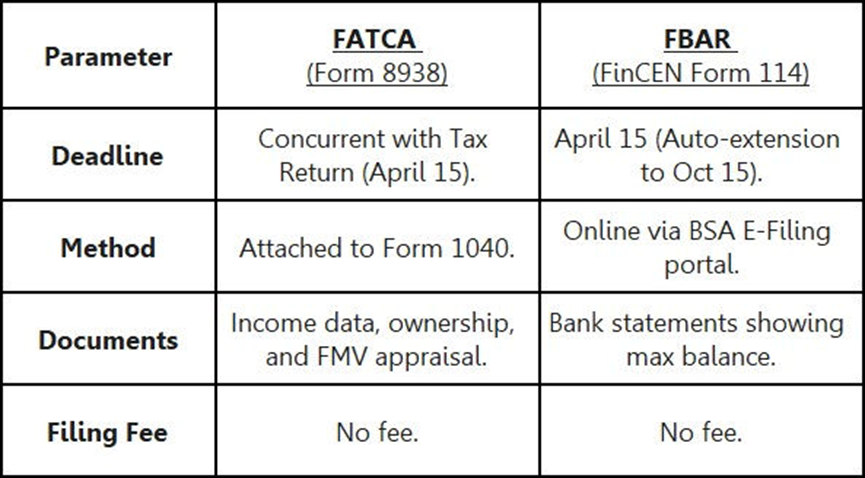
Form 8938 (FATCA): Reporting specified foreign financial assets when the applicable reporting threshold is met. Directly held foreign real estate is not itself reportable on Form 8938. Different rules may apply where the real estate is held through a foreign entity.
FBAR (FinCEN Form 114): Reporting certain foreign financial accounts when the aggregate value of reportable accounts exceeds $10,000 at any time during the calendar year. An Israeli bank account receiving rental income may therefore be reportable, depending on the account holder's circumstances. The real estate itself is not an FBAR-reportable account.
FBAR deadline: April 15, with an automatic extension to October 15.
Official Source: IRS - Comparison of Form 8938 and FBAR
2. France: Real Estate Wealth Tax (IFI)
France is among the strictest countries regarding foreign real estate. In 2018, the general wealth tax (ISF) was replaced by the IFI (Impôt sur la Fortune Immobilière).
The Criterion: French residents whose global real estate assets (including Israel) exceed €1.3 million.
The Need for Appraisal: The IFI requires taxable real estate to be valued at its real market value (valeur vénale réelle) as of January 1 of the relevant tax year. A professional appraisal may be useful to support the declared value, but French law does not universally require a professional appraisal for every property.
Deadline: May-June (depending on the department/region and filing method).
Official Source: Service-Public.fr - Impôt sur la fortune immobilière (IFI)
3. Canada: Foreign Income Verification Statement (Form T1135)
Form T1135 may be required when a Canadian resident holds specified foreign property with a total cost amount exceeding CAD $100,000 at any time during the year, subject to exclusions and the taxpayer's circumstances.
The Criterion: Canadian residents holding foreign assets with a total cost amount exceeding $100,000 CAD.
Deadline: Form T1135 is due on the same date as the taxpayer's income-tax return. For most individuals this is April 30; for self-employed individuals, the applicable deadline may be June 15.
Official Source: CRA - Foreign Income Verification Statement (T1135)
4. United Kingdom: Statutory Residence Test & Worldwide Income
The UK tax system is based on residency, and recent years have seen a significant tightening of regulations regarding offshore assets.
The Criterion (Residency): UK residents normally pay UK tax on foreign income and gains, subject to the applicable rules and reliefs. Since 6 April 2025, the former remittance basis has been abolished and the Foreign Income and Gains (FIG) regime provides specific relief for qualifying new residents.
The Remittance Basis: While historically "Non-Dom" residents could avoid UK tax on foreign income not brought into the country, this regime is undergoing dramatic structural reforms effective 2025.
Capital Gains Tax (CGT): UK residents may be liable to UK Capital Gains Tax on gains from the disposal of overseas property, subject to the applicable rules and reliefs. Where foreign tax is also paid, relief may be available under UK domestic law and the applicable tax treaty.
Deadline: January 31st (for online Self-Assessment filing).
Official Source: GOV.UK - Tax on foreign income
5. Russia: Currency Control & CFC Rules
Russian rules include specific reporting obligations concerning foreign accounts, foreign assets and controlled foreign companies.
Currency Control: Foreign bank-account notification and reporting in Russia are governed by Russian currency-law rules and should not be conflated with tax residence. Depending on the individual's status and the type of account, notification and reporting obligations may apply to foreign bank accounts.
CFC (Controlled Foreign Corporations): If the property is held through a legal entity (e.g., a family holding company), under Russian CFC rules, a person may be treated as a controlling person where their direct or indirect participation exceeds 25%. A lower threshold of more than 10% can apply where the combined participation of Russian tax residents exceeds 50%, and control may also arise on other statutory grounds.
Personal Income Tax (PIT): Rental income from Israeli property may be subject to Russian personal income tax. Since 2025, Russian personal income taxation uses progressive rates for relevant categories of income, so the applicable rate depends on the taxpayer's circumstances and the relevant tax base. Failure to comply with applicable reporting obligations may result in penalties, interest or other enforcement measures, depending on the type of violation and the applicable rules.
Deadline: April 30th (for filing the 3-NDFL annual income tax return).
Official Source: Federal Tax Service of Russia - Individual Income Tax
The Importance of Professional Appraisal in International Reporting
Different countries use different valuation concepts. Depending on the relevant tax rule, the required figure may be fair market value, cost amount, adjusted cost basis, deemed proceeds or another statutory value. The applicable valuation date and methodology should be confirmed with the client's local tax adviser.
Prevention of Double Taxation: Foreign tax credits generally depend on foreign tax paid on qualifying foreign-source income or gains and on the applicable domestic rules and tax treaty. A property valuation may support the underlying tax calculation where value is relevant, but it does not itself create a foreign tax credit.
Audit Protection: An independent appraisal can provide documented professional support if the declared value is later reviewed or challenged by a tax authority.
Potential Consequences of Non-Reporting
Failure to comply with foreign-property reporting requirements may result in penalties, interest and, in certain circumstances, additional enforcement measures. The applicable consequences vary significantly between countries, forms and types of violations. Taxpayers should obtain advice from the relevant local tax professional when a reporting obligation is unclear.
Procedures, Deadlines, and Required Documents
While the filing itself usually carries no government fee, the indirect costs (professional fees and potential non-compliance fines) create the financial burden.
U.S. Reporting (IRS & FinCEN)
FBAR penalties: Civil penalties may apply for non-willful or willful violations. The maximum penalties are adjusted periodically for inflation, and willful violations may carry substantially higher penalties.
France (DGFIP)
Method: Online via impots.gouv.fr as an annex (Form 2042-IFI).
Documents:
Property valuation: An independent Israeli appraisal may provide supporting evidence for the property's declared value where appropriate. There is no universal requirement for every Israeli property to have a professional appraisal for IFI.
Amortization Schedule: Proof of debts (mortgages) related to the property, which reduce the taxable base.
Filing Fee: No fee.
Canada (CRA)
Method: Online via NETFILE/EFILE or by mail.
Documents:
Cost Amount Documentation: Purchase and improvement records, with amounts translated into CAD using the applicable exchange rate for each relevant date.
Tax and rental documentation: Rental income, expenses and foreign taxes may need to be reported through the applicable Canadian tax forms. Form T1135 itself is a foreign-property reporting form and should not be presented as the form used to calculate the taxpayer's rental income tax or foreign tax credit.
Filing Fee: No fee.
Theoretical Example: A French Tax Resident with an Israeli Property
A Tel Aviv property owner living in France stands at the intersection of two tax systems. A French tax resident may need to establish the market value of an Israeli property for French tax purposes, including IFI where applicable. An independent Israeli appraisal can provide professional support for that valuation, although a professional appraisal is not universally mandatory.
1. For the Israel Tax Authority (Israeli Property Tax Developments)
Israel has been developing a renewed Property Tax framework for land, with legislation and implementation rules changing during 2026. The applicable rules, valuation methodology, exemptions and reporting requirements should be checked against the current legislation and official guidance at the time of the assessment.
Where an Israeli property valuation is required, IL APPRAISER can assess the property and its relevant land and planning characteristics for the applicable purpose and valuation date.
2. For the French DGFIP (IFI Tax)
Jan 1st Valuation: France requires the market value at the start of the tax year.
Deductible Liabilities: Eligible property-related debts may be deductible from the IFI taxable base, subject to French law and the specific circumstances. A potential or future Betterment Levy should not be treated as automatically deductible.
3. Foreign Tax Credit (Prevention of Double Taxation)
Property valuation: Where market value is relevant to the tax calculation, an independent Israeli appraisal can provide professional evidence of the property's value for the relevant date.
Recognized Expenses: Documenting investments that raise the "cost basis" to reduce future Capital Gains Tax (Mas Shevach) in Israel and its reflection in France.
The Owner’s Checklist (What to Request from the Appraiser):
Market Value Appraisal.
Relevant Planning and Building Rights Information, where required for the valuation.
Additional English or French valuation documentation, where requested by the client or professional adviser.
Information on Eligible Property-Related Liabilities, where relevant to the client's French tax analysis.
Strategic Summary: The "Guesswork Trap"
IDifferent jurisdictions use different valuation rules. Depending on the specific tax matter, the relevant figure may be fair market value, cost amount, adjusted cost basis, deemed proceeds or another statutory value. Relying on an old estimate or a "guess" exposes the owner to either over-exposure (paying too much tax) or under-exposure (heavy fines for a deficit).
An independent appraisal can provide documented professional support for the property's value where a valuation is relevant to a tax, legal or financial matter. The client's local tax or legal adviser determines how the valuation should be used under the applicable rules.
We are here to assist with independent Israeli property valuations for international reporting and other tax, legal and property-related matters.
Found this guide helpful?
Share it with fellow investors and help them navigate the Israeli real estate market.


Comments